

Slow Your Roll
To ward off social-media brain rot, John Lopez recommends watching a movie that takes its time.

John Lopez is another old friend I was excited to tap for the spring issue. He's a screenwriter, producer, and director, as well as a former member of the WGA's AI working group. He’s no Luddite, but he has serious and very well-informed concerns about the ways technology is encroaching on human creativity, and I'm proud to share this story he wrote for us about the role cinema can play in protecting us from internet-induced brain rot. —Mike Hogan
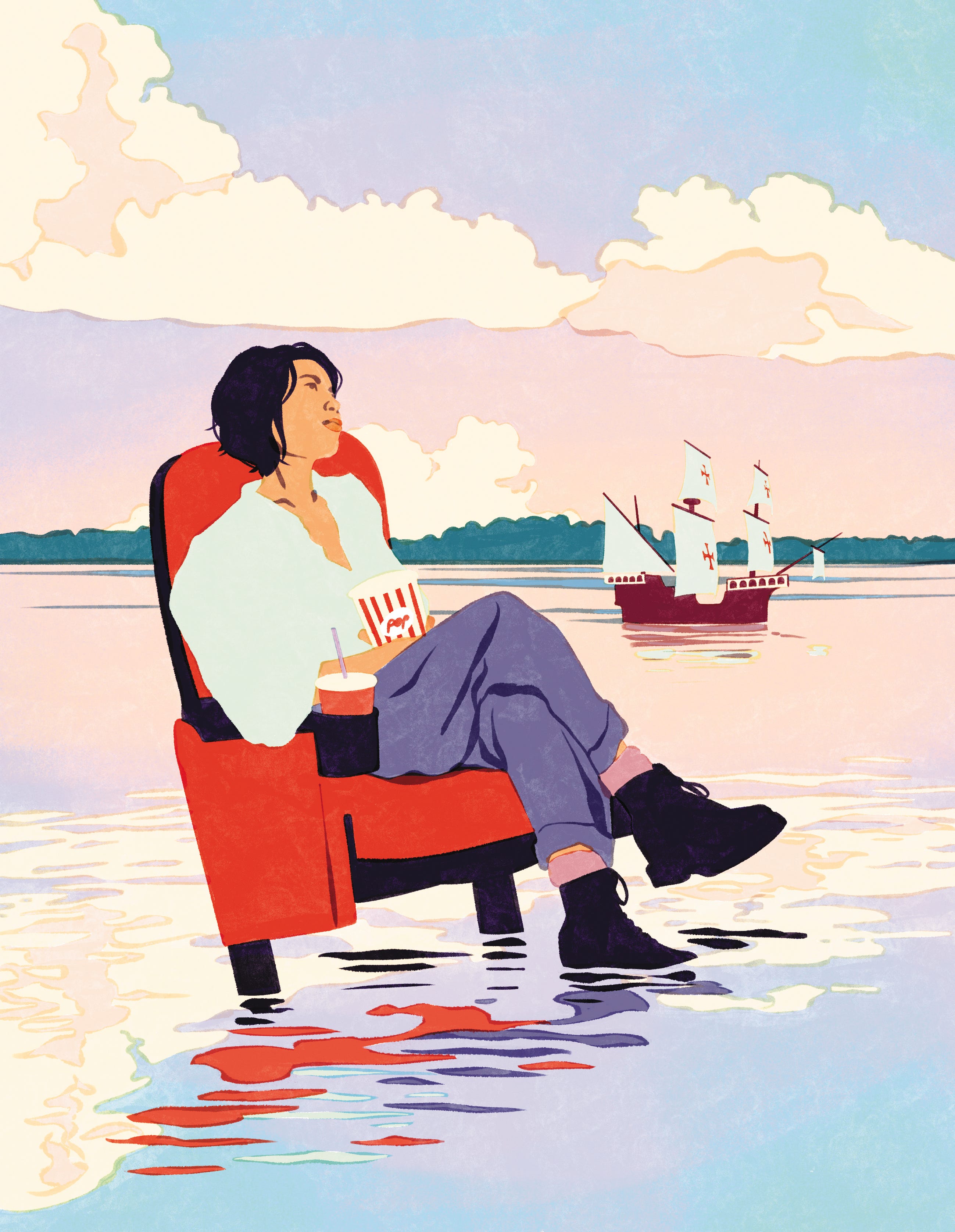
You know the feeling: the algorithm catches you one lazy afternoon, and hours melt in the blink of an eye. You come to, dehydrated, achy, struggling to focus. Or at night, your couch sucks you in. You bounce from Netflix to Hulu to HBO, trying to find your “next show” or catch up on one that all the memes insist you simply have to watch. Instead, you start 15 minutes of three different series and two mid-’90s movies, then retreat to your phone. Before long, a sickly yellow fog buzzes behind your eyes—the undeniable mental vertigo of brain rot.
The 21st century presents quite the paradox for cinephiles. To those born before the smartphone era, it was hard to imagine ever having too much cinema. Yet, we are now deluged in moving images, fast cuts, unrelenting edits. “Firehose” doesn’t do it justice. It’s audio-visual drowning at 200 miles per hour. And this was before AI slop turbocharged everything.
At the same time, the cinematic experience—cloistered in a dark room with strangers and a bucket of popcorn—is allegedly less relevant than ever. The box office is stuck in a post-pandemic slump. Hollywood’s holy mountain, L.A.’s ArcLight Cinemas, remains shuttered to this day. Ted Sarandos has called theaters “outdated,” while Netflix’s attempted purchase of Warner Bros. had even James Cameron wondering how long the theatrical release will survive.
It all seems dismayingly inevitable. Who can fight cultural evolution, let alone American hyper-techno-capitalism? But a trend bubbling up on the edge of cinema offers a rare counterpoint: films that forsake the fast cuts of Jason Bourne or The Fast and the Furious. Auteurs like Kelly Reichardt, Nuri Bilge Ceylan, Jia Zhangke, and Lav Diaz made a virtue of microbudgets by slowing the edit, locking off the camera, and letting scenes run, inspiring a new generation of filmmakers like Scott Barley and Bi Gan.
It’s a stark contrast to the lessons of social media. Might it also be a reaction to the brain rot lying in wait behind our screens? Sundance’s Giulia Caruso, director of its Catalyst and Industry labs, thinks that’s a distinct possibility: “I actually had this conversation with a couple colleagues at Sundance. We talked about the comparison with the food industry, and the idea of slow food and fast food.” Just as consumers came to crave slower cooking in a world dominated by McDonald’s, there may be a growing need for filmmaking that cuts against the grain of short attention spans and distracted viewing. “As an audience [member], you’re not trying to do your email and watch a movie,” Caruso says, “and as a filmmaker, you’re not trying to make a movie that is only [for] Netflix.”
Of course, slow cinema is far from a new phenomenon. Ask any Cannes aficionado: from Ingmar Bergman to Bela Tarr, Andrei Tarkovsky to Apichatpong Weerasethakul, international art films have long had a reputation for unfurling at the speed of molasses. As the streaming model has come to dominate our entertainment ecosphere, such filmmaking seems especially risky. Holding any one cut too long may earn a lethal pause from the viewer: to get up, get a snack, go to the bathroom or, heaven forbid, switch to something else. For a generation of image creators weaned on the first law of social media—riding the algorithm means tracking a video’s dopamine hit second by second—it seems downright heretical.
The theatrical experience, however, isn’t bound by that dynamic. The structure that makes streaming seem like a bargain—$25 for a month of infinite choice, viewed at your leisure versus a one-time gamble on an experience you may not like—actually rewards slow filmmakers. It’s a lot easier to bounce around a Netflix queue or swipe left, right, up, and down on your phone than it is to walk out on something you’ve paid for. When you buy a theatrical ticket, you’ve purchased an increasingly precious commodity in the 21st century: commitment.
In an era drowning in TikTok’s quick cuts, this is something distinct, different, even refreshing. It induces a special feeling, one that’s specifically the point of filmmaking for director Lav Diaz, an icon of slow cinema: “I have experiences like those with the films of Tarkovsky and Ozu. You go into this great slumber, then you wake up and you’re part of it. All your molecules are integrated into the universe. That kind of feeling, it’s important.”
Diaz is known for making hours-long mega-movies that would break the gears of Hollywood. His latest, Magellan, might be his most commercial yet, clocking in at just shy of three hours. Like his hero Andrei Tarkovsky, Diaz employs long cuts to force a viewer to meditate on images: “If you cut five seconds here, 10 seconds there, maybe [add] 15 seconds, or one minute more, those things are huge in terms of feel…. Your senses are working.” His stories are told through gradual revelation; tension builds through characters materializing on the horizon. Diaz likens his art to a relaxed conversation with a friend: “When I was shooting Magellan, [it’s] like I’m having coffee with him.”
The final impact can be just as stimulating as the biggest blockbuster—if the viewer understands the stillness is the point. Slow cinema demands patience. As Diaz puts it, “You might miss the movement of the leaves. You might miss that little wave, and it’s creating something.” In Magellan, the camera’s steady consideration of Gael Garcia Bernal emphasizes the spiritual turmoil within the eponymous explorer, allowing us to ponder his internal contradictions of ambition and faith, hope and violence. The still frame also magnifies the power of key moments, such as when Magellan “heals” a village child with a Catholic icon. You not only see but feel how this became a fulcrum point in Philippine history. But to get that feeling, the audience member’s mind must be as still as the frame.
This kind of viewing has always been hard at home. Getting through a Tarkovsky movie can feel like a Sisyphean task when the pause button beckons. The best way to watch Solaris or Mirror is locked in a theater, where captive time allows for patience and reflection. As Diaz explains, “Seeing other cultures, other universes, other ways of seeing things. You cannot see them on your laptop or cell phone. You have to be there; all your senses must be moving. It’s a whole way of seeing a life.… It’s like listening to a good album.”
To fight for such peace these days seems quixotic, to say the least. Yet in Los Angeles, second-run theaters like the New Beverly and Vista are busier than ever, as are lushly appointed nonprofit screens at the American Cinematheque and the Academy Museum. Together, they employ droves of curators to hunt down rare prints: IB Tech, nitrate, 70 mm. Last fall, the VistaVision screenings of Paul Thomas Anderson’s One Battle After Another were some of the hottest tickets around. Such screenings have become see-and-be-seen affairs, with Gen Z influencers all decked out for a night on the town.
Despite all the doom and gloom over the theatrical experience, neither Diaz nor Caruso thinks it will truly go away. For Diaz, it’s a deep, artistic conviction, the entire point of what he does: “The theater experience will not die. It will stay forever in a way. It is the nature of cinema.” Even for Caruso, there is an abiding commercial reason to believe in theaters: “I do think when people have less money and less time, they become more intentional in how they use it.” It’s a dynamic filmmakers should be aware of, another way they can stand apart from social media and streaming. As Caruso says, “I think the idea of reclaiming this [so-called] slowness, in terms of intentional, active viewing and trusting the audience, is something that requires the confidence of not trying to do something else at the same time.”
Just as Americans eventually woke up to the physiological perils of fast food—the diabetes, the weight gain, the general feeling of blegh—maybe we’ve reached a turning point with the mental perils of social media and streaming. Perhaps, with an internet increasingly engineered to induce ADD in us, the theatrical experience will come to be seen as a mental health necessity. Where else can we escape the onslaught of our algorithmic feeds, forsake the easy dopamine hits of omnipresent digital life? How else can we find the breathing room to empathize deeply with experiences and understandings of the world so different from our own?
No less than Pope Leo himself recently argued to an audience of filmmakers, Spike Lee and Cate Blanchett among them, that cinema is a spiritual necessity for us to confront the challenges of our modern world. The pontiff said, “In the darkness and silence, vision becomes sharper, the heart opens up, and the mind becomes receptive to things not yet imagined.” The Pope’s words are a near perfect encapsulation of what the theatrical experience can be at its best, and it’s what Diaz strives to capture in all his work: “For me, I still have faith in cinema…. Great cinema is having faith in life—that you can create something that contributes to humanity’s goodness.”
—John Lopez
Nominees Announced for 2026 Gotham Television Awards
New York, NY (April 28, 2026) – The Gotham Film & Media Institute announced today the nominations in twelve competitive award categories for the 2026 Gotham Television Awards, recognizing a range of series and performances.
“With today’s nominations, our third annual Gotham Television Awards celebrates an incredible year of breakthrough comedies, dramas, and original films, as well as a newly expanded Limited or Anthology Series category recognizing where some of television’s boldest work is being made,” said Jeffrey Sharp, Executive Director of The Gotham. “As the first awards show of the new television season, we’re proud to bring together the industry’s most exciting voices, celebrate the year’s achievements, and deepen our commitment to supporting the creative community we represent here at The Gotham.”
Find the full press release, which includes all nominees, here.
The Gotham Television Awards will take place in New York City on June 1.
read a book in the morning before touching any electronics to help your brain recover and prepare to watch a MOVIE