

Working-Class Zero
Matt Johnson’s “Tony” is less an Anthony Bourdain biopic than a story of masculine role models.

IN THIS NEWSLETTER
Editor’s Letter
The Gotham presents “Fundraising Your Documentary”
EDITOR’S LETTER

Tony is not really a movie about Anthony Bourdain—it’s about the myth of individual exceptionalism. Director Matt Johnson renders a pivotal summer in the life of 19-year-old Tony (Dominic Sessa as a young Bourdain), an aspiring writer who is aging out of his precocious years, though it is still charming when he cannot pronounce “bildungsroman” correctly in front of university professors. He impulsively quests from New Jersey to the briny air of Provincetown, MA, in pursuit of his crush (Emilia Jones), who’s spending the summer there—but his heart sinks when he realizes she is seeing her coworker at the local pizzeria. So far, so generically teenage boy. He drinks too much at the bar of a local restaurant and is kicked to the curb by its head chef (Antonio Banderas) and a line cook, Sal (Leo Woodall), who relieves Tony of the money he stole from his father, stranding him in P-Town.
This stroke of bad luck sets off a formative chain of events around the restaurant. Banderas’s character, always addressed as “Chef,” allows Tony to spend nights on his back-porch hammock on the condition that he wash dishes in the kitchen; an unceremonious bucket of sea water to the face is a hungover Tony’s daily alarm clock. Tony sees the skill with which Sal can shuck oysters—coupled with the swaggering charisma he oozes at parties, seductive one moment, brutish and destructive the next—and decides to mold himself after that image. The arc of the movie is less about culinary skill than about Tony bouncing back and forth between Chef and Sal, two differing role models for the kind of guy he could become: the aesthete, intellectual restaurateur, and surrogate father figure; the rule-bucking, working-class maverick, and bad-influence older brother.
Bourdain, of course, landed in the middle. But rather than reductively limning out “the Anthony Bourdain origin story,” Tony deals with how we define who we are through the choices we make—and the people we try to emulate. As Tony tries to shuck an oyster in the kitchen, the primary dramatic focus is not on whether he succeeds but on an argument between Chef and Sal; Tony accidentally (but quietly) jams the knife into his palm as he watches his twin influences duke it out for dominance. In this way, Tony fits neatly alongside Johnson’s other movies, in which characters make decisions informed by the allure of masculine cultural archetypes—and the thin, often self-deluding line between alpha males and beta males. In Johnson’s BlackBerry (2023), Jay Baruchel plays a version of Mike Lazaridis, the original co-CEO of BlackBerry. He is deeply invested in thoughtful, high-quality engineering, which allowed him to successfully produce a working BlackBerry in the first place, but struggles with asserting himself in the style of a stereotypical CEO; on the phone to a company trying to back out of a $16 million payment, he crumbles into bumbling torrents of “uhs” and “okays.” Enter his new co-CEO, Jim Balsillie (Glenn Howerton of It’s Always Sunny in Philadelphia), an ill-adjusted, Harvard Business School–educated investor to whom Mike pitched an early version of the BlackBerry. It’s Johnson and co-screenwriter Matthew Miller’s invention that Balsillie swooped in to buy the company after a series of paranoid, aggressive power plays got him fired from a previous CTO role.

Johnson is intrigued by characters who make bad choices. BlackBerry locates doom for the company in the way that Balsillie’s mercenary-capitalist, proto-grindset management training begins to rub off on Mike, who wants to be seen as the assertive guy in control. (It’s telling that Balsillie pitches the BlackBerry as a device small enough to hold in your “fist,” rather than your “hand.”) A lot of this comes down to the influence of pop culture, which is especially evident in the projects that Johnson stars in. His long-running cult-favorite series, Nirvanna the Band the Show (2007–09, 2017–18), follows a hapless musical duo (Johnson and Jay McCarrol) who process reality through references to Indiana Jones and Back to the Future, but whose knowledge of pop culture essentially stops in the aughts, making it impossible for them to gracefully interact with the real world. Social mishaps ensue whenever they have to leave the hermetic world of their house, wallpapered with Criterion posters and photos of the two of them hanging out. (There’s something akin to the alpha/beta relationship in the draw of American pop culture for two Canadian guys, too.)
Part of the joke with Nirvanna is how well suited it is to the age of a fracturing monoculture. Matt and Jay constantly draw on boyish notions of heroism that defined the ’80s blockbuster, but which have lost mass familiarity as culture splinters. It’s funny to be thinking about Nirvanna the same week as a film that aims for wide appeal fails spectacularly: Will Gluck’s One Night Only (aka “The Purge for sex”) succumbs to predictably conservative, heteronormative pitfalls, thanks to a retrograde lack of imagination. A couple other films debuting this weekend dig deeper into the relationship between the individual and the group, and in how pop culture can open new doors for self-discovery on the fringes—Jane Schoenbrun’s Teenage Sex and Death at Camp Miasma; Kent Jones’s Late Fame. In circling the irrevocable hold that culture has on us, Johnson says: do with that knowledge what you will. — Chloe Lizotte

THE GOTHAM PRESENTS “FUNDRAISING YOUR DOCUMENTARY”
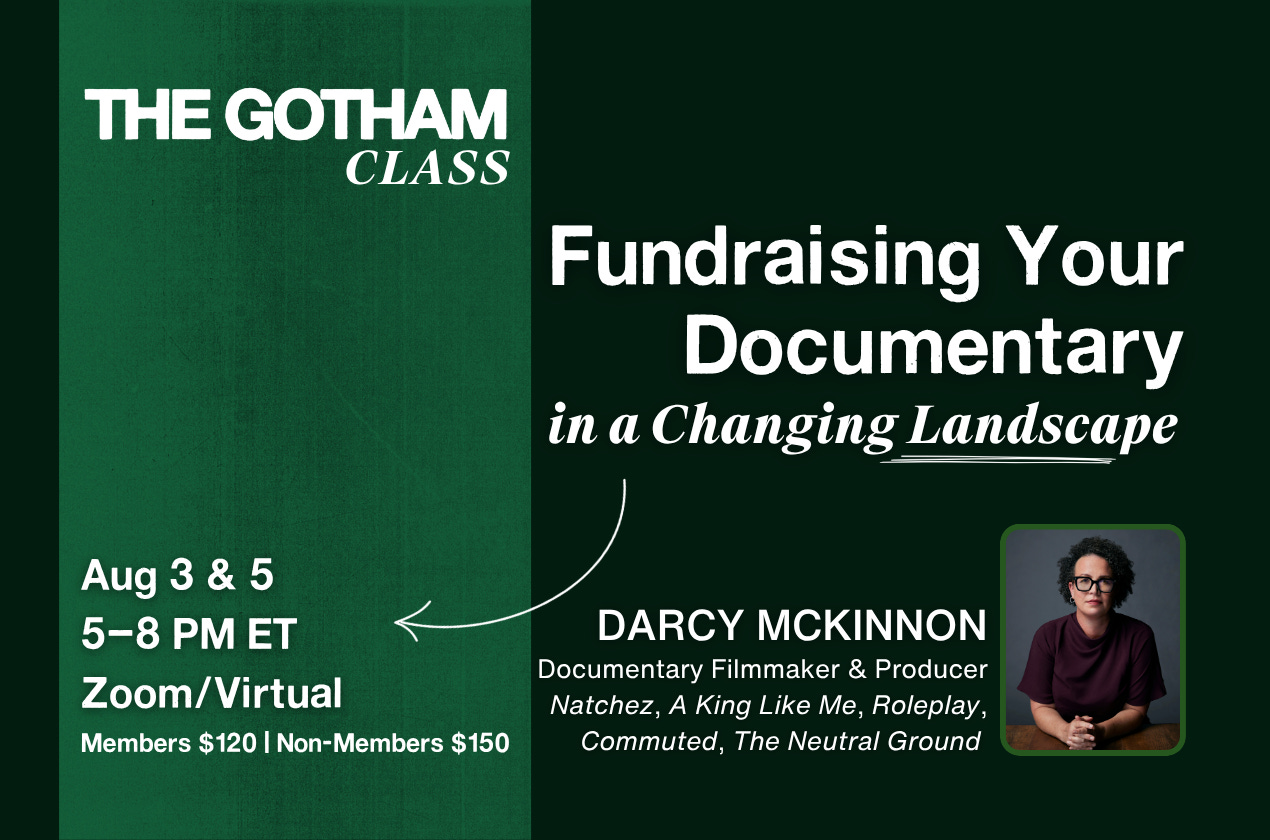
Starting Monday: Fundraising Your Documentary with Darcy McKinnon
August 3 & 5 / 5–8pm ET / Virtual
Feeling overwhelmed by the fundraising process? Not sure how best to get your film funded? Join us for Fundraising Your Documentary in a Changing Landscape, led by filmmaker Darcy McKinnon (Natchez; A King Like Me; Roleplay; Commuted; Algiers, America; Under G-d; Look at Me! XXXTENTACION).
The first session will cover the fundamentals of fundraising for docs. Topics include the types and impacts of different kinds of financial investments, setting up your legal and financial entity, how money is tied to distribution, and the development of funding materials.
The second session will focus on case studies of some recent films Darcy produced, as a way of discussing the current distribution landscape and how it relates to your production, impact and distribution fundraising.
Gotham Members get 20% off! Just RSVP through your Member Dashboard.